

You bit into something hard and now your tooth hurts, feels sharp, or just doesn’t feel right. Your first thought is probably, “How bad is this?”
The right cracked tooth treatment depends on how deep the crack goes and whether it has reached the nerve, so the same injury could mean a simple filling for one person and an extraction for another.
Your damaged tooth might look fine from the outside while still having a serious crack underneath. That’s why guessing at the fix on your own rarely works out.
A dentist has to look closely, sometimes with special tools, to figure out exactly what kind of fracture you’re dealing with before choosing a treatment.
This guide walks you through what to do right after cracking a tooth, how dentists check the damage, and why the type of crack changes everything about your options.
You’ll learn when bonding or a crown can save your tooth, when a root canal comes first, and when extraction is truly the best choice.
Key Takeaways
- Acting quickly after a tooth injury can protect the nerve and improve your chances of saving the tooth.
- Dentists use exams and imaging to figure out how deep a crack goes, which decides whether you need bonding, a crown, a root canal treatment, or an extraction.
- Waiting too long to treat a cracked tooth can turn a simple fix into a more serious problem, so early evaluation matters.
What to Do Immediately After Cracking a Tooth
A cracked tooth needs quick action to protect it from more damage and to keep you comfortable until you see a dentist.
The steps you take in the first few hours can affect whether your tooth needs a simple fix or a more involved treatment.
Protect the Tooth Until Your Dental Visit
Rinse your mouth with room temperature water first. Skip hot or cold water since temperature extremes can make a cracked tooth more sensitive.
Stick to soft foods like yogurt, eggs, or mashed potatoes. Chew on the opposite side of your mouth to avoid putting pressure on the crack.
Here’s a quick checklist to follow:
- Apply a cold compress to your cheek for 15 minutes at a time to reduce swelling
- Take an over-the-counter pain reliever like ibuprofen to manage discomfort
- Cover sharp edges with dental wax or sugar-free gum if the crack is bothering your tongue or cheek
- Avoid sticky or hard foods that could pull on the tooth or cause more pieces to break off
These steps won’t fix the crack, but they can keep things from getting worse before your appointment.
Symptoms That Need Same-Day Dental Care
Some symptoms mean you shouldn’t wait to see a dentist. Contact your general dentist or seek emergency dentistry right away if you notice any of the following.
Watch for these warning signs:
| Symptom | What It May Mean |
| Sharp tooth pain when biting down | The crack may have reached the nerve |
| Ongoing sensitivity to temperature | Hot or cold foods trigger lingering pain, not just a quick zing |
| Pain when chewing that doesn’t fade | The crack could be spreading deeper into the tooth |
| Swelling near the gum line | This can signal infection setting in |
| Visible fracture with bleeding | The crack has broken through into softer tissue |
If you notice swelling, a fever, or a bad taste in your mouth, these can point to infection. That kind of dental emergency calls for same-day care, not next week.
How Dentists Determine the Extent of the Damage
A cracked tooth is not a one-size-fits-all problem. Your dentist looks at how deep the crack goes, where it sits, and whether it has reached the nerve before deciding on a treatment plan.
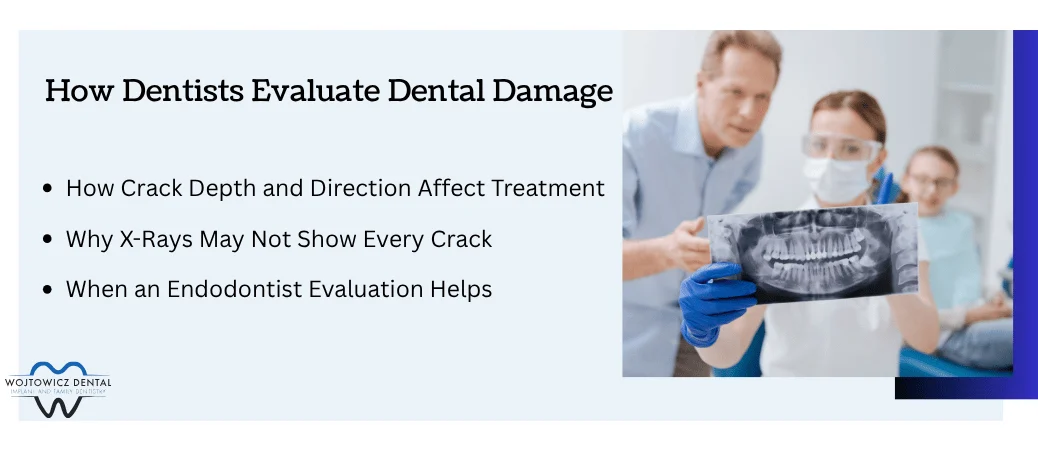
How Crack Depth and Direction Affect Treatment
The direction and depth of a crack line matter more than how the crack looks on the surface.
A crack that stays in the enamel and dentin is usually easier to treat. But if it reaches the pulp, where the nerve and blood vessels live, you may need a root canal before a crown can be placed.
Cracks that run between the cusps (the pointed parts of your tooth) often need a crown to hold the tooth together. If the crack runs down into the root, the outlook is not as good.
Dentists assess crack depth and location to decide between a crown or a smaller fix like an onlay.
Why X-Rays May Not Show Every Crack
X-rays are helpful, but they don’t catch everything.
Cracks often run in a direction that doesn’t show up well on a flat X-ray image. This is especially true for tiny cracks in the tooth structure that haven’t spread far yet.
Because of this, your dentist may need to use other tools too. These can include:
- A bright light shined through the tooth (called transillumination)
- A bite test to see which tooth hurts when you chew
- A dye that can highlight the crack line
- A magnifying tool or microscope for a closer look
Using more than one method gives a clearer picture of what’s really going on inside your tooth.
At Wojtowicz Dental Implant and Family Dentistry, Dr. Emily Wojtowicz brings a background in Biomedical Science and molecular genetics research to this diagnostic process.
Her scientific foundation, combined with her commitment to continuous learning and advanced dental techniques, helps her carefully evaluate the damage and determine which treatment may give your tooth the best chance of being saved.
When an Endodontic Evaluation May Help
Sometimes your general dentist will refer you to a specialist for a closer look.
An endodontist focuses on the inside of the tooth, including the pulp and root canals. This makes them well suited to check if a crack has reached the nerve.
This step is especially common with molars, since they have more cusps and a higher chance of hidden cracks between them.
Endodontists specialize in diagnosing cracked teeth that may not be easy to spot with a standard exam.
If your crack involves the nerve, working with a specialist can help you avoid guesswork. Catching the problem early gives you a better chance at saving the tooth.
How the Type of Fracture Guides Your Treatment
Not all cracks are the same, and the depth and location of your fracture determine whether you need a simple fix or a more involved procedure.
Your dentist will look at how far the crack travels and whether it reaches the gum line or root before recommending treatment.
Craze Lines and Small Surface Chips
If you notice thin lines on your tooth’s surface, don’t panic. These are called craze lines, and they only affect the outer enamel.
You won’t feel pain from these, and they don’t put your tooth at risk. Many adults have them without even knowing it.
Small chips are a bit different, but they’re still minor. Your dentist can often smooth out a chip or use bonding to repair the surface.
This keeps your tooth looking and feeling normal without needing anything more invasive.
Fractured Cusp
A fractured cusp happens when part of the chewing surface breaks off, usually around an old filling. This type of crack doesn’t reach the pulp, so your nerve stays protected.
You might feel some sensitivity when biting down, but it’s usually mild. The good news is that treatment depends on how much healthy tooth structure remains once your dentist looks at the fracture.
If enough of your tooth is intact, a filling or crown will do the job. In some cases, an onlay might work better to cover the damaged area while protecting the rest of your tooth.
Cracked Tooth Extending Toward the Root
This type of crack starts at the chewing surface and moves down toward the root, but it hasn’t fully split your tooth yet. You may notice sharp pain when you bite down or release pressure, especially with hot or cold foods.
This happens because the crack can open and close, irritating the nerve inside. If it’s caught early, a crown might be enough to hold your tooth together and stop the crack from spreading.
But if the crack has already reached the pulp, you’ll likely need a root canal before your dentist places a crown. Waiting too long can let bacteria sneak in, so it’s best to get this checked quickly.
Split Tooth and Vertical Root Fracture
A split tooth means the crack has gone all the way through, dividing your tooth into two separate pieces. This is more serious, and at this point, saving the whole tooth usually isn’t possible.
A vertical root fracture is even harder to treat. This crack starts in the root and moves upward toward the chewing surface, often without any obvious symptoms until infection sets in.
Because both of these fractures involve serious damage below the gum line, extraction is typically the recommended treatment.
Your dentist will likely discuss replacement options like an implant or bridge to restore your smile afterward.
When Bonding, an Onlay, or a Dental Crown Can Save the Tooth
The right fix for your cracked tooth depends on how deep the crack goes and how much healthy tooth structure is left. Small chips often just need bonding, while deeper cracks may call for an onlay or a full crown.
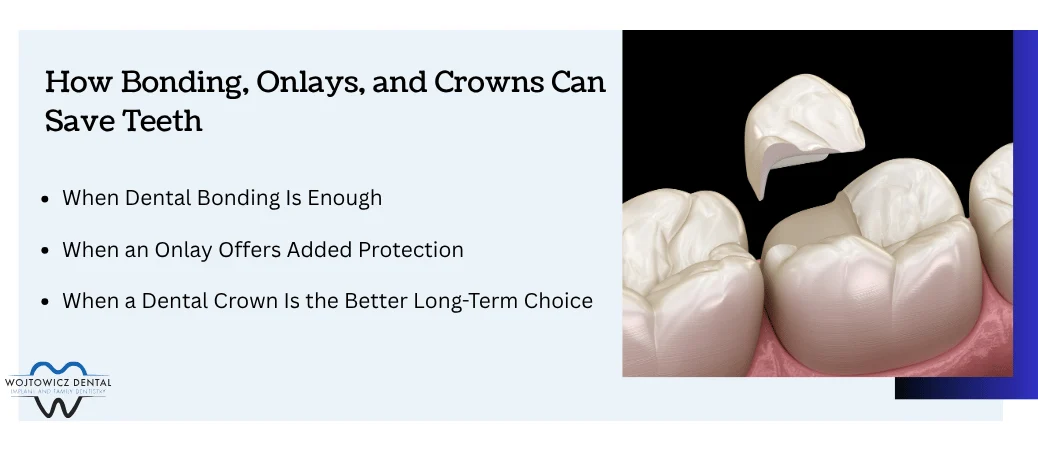
When Dental Bonding Is Enough
Bonding works well when your crack is small and doesn’t reach the dentin or affect your bite.
If the damage is limited to the enamel surface, your dentist can apply a tooth-colored filling to fill the crack and smooth out the edges.
This option is quick, usually done in one visit, and doesn’t require removing much of your natural tooth. It’s also the most affordable choice among the three.
Bonding won’t hold up well if you have a deep crack line or you grind your teeth at night. In those cases, the resin can chip or wear down faster than expected.
Your dentist will check the crack’s depth and location before recommending this route.
When an Onlay Offers Added Protection
An onlay makes sense when the damage covers one or more cusps but hasn’t spread across the entire tooth.
This restoration fits over the damaged area like a puzzle piece, covering more surface than a filling but less than a crown.
You’ll keep more of your natural tooth structure with an onlay compared to a crown, since an onlay preserves more natural enamel and dentin than a full crown would.
This makes it a good middle-ground option when your tooth needs more support but isn’t severely damaged.
Onlays are custom-made from porcelain or gold, so they typically need two dental visits. They work best when your crack hasn’t reached the tooth’s inner structure or caused nerve pain.
When a Dental Crown Is the Better Long-Term Choice
A dental crown becomes the better choice when your crack runs deep, spreads across multiple cusps, or puts the entire tooth at risk.
A crown may be recommended when a cracked molar has significant structural damage that an onlay simply can’t support.
Since a crown covers the whole tooth, it protects every surface from further cracking or breaking.
This full coverage helps hold the tooth together, especially if the crack line extends toward the gum line or into the dentin.
You’ll need more of your natural tooth shaved down for a crown than for bonding or an onlay. But for a severely damaged tooth, this trade-off is often worth it to avoid extraction and keep your natural tooth in place longer.
When Root Canal Treatment Is Needed Before Restoration
If your crack has reached the soft tissue inside your tooth, a crown or bonding alone won’t fix the problem. You’ll likely need a root canal first to remove damaged tissue and stop pain before your dentist can rebuild the tooth.
Signs the Pulp May Be Involved
Your tooth has a soft center called the pulp, and it holds nerves and blood vessels. When a crack reaches this area, you’ll usually notice some clear warning signs.
Watch for these symptoms:
- Sharp sensitivity to temperature that lingers after eating hot or cold food
- Pain when chewing or biting down, especially when you release the bite
- Sudden or spontaneous tooth pain that comes and goes without warning
- Swelling or tenderness in the gum near the cracked tooth
These signs often mean bacteria have reached the pulp. This can happen through histologic bacterial pathways inside deep cracks.
Your dentist may also take an X-ray to check for infection near the root tip before deciding on treatment.
What Root Canal Treatment Does
A root canal removes the infected or damaged pulp tissue from inside your tooth. Your dentist or an endodontist cleans out the canal, shapes it, and fills it with a material that seals the space and keeps bacteria out.
This step stops the tooth pain caused by infected pulp and lowers your risk of an abscess forming later. In cracked teeth, dentists sometimes place a small barrier just past the deepest point of the crack.
This helps block bacteria from reentering the canal and can also add strength to the tooth near the gumline.
Root canal treatment usually takes one or two visits, depending on how complex the crack and infection are. Afterward, your tooth is still alive in function but no longer has living nerve tissue inside it.
Why a Crown Is Usually Placed After a Root Canal
Once the root canal is done, your tooth still needs protection. Removing the pulp can make the tooth more brittle, so a dental crown is placed to cover it and hold the remaining structure together.
Delaying a crown after root canal treatment can raise the risk of the tooth cracking further or getting reinfected. Getting the crown placed quickly gives you the best chance of keeping the tooth long term.
Your dentist may also ask you to avoid chewing on that side until the crown is ready. This simple step protects the tooth while it’s most vulnerable and gives your root canal treatment the best chance of success.
When Tooth Extraction and Replacement Are the Best Options
Some cracks go too deep for a crown or bonding to fix safely, and in these cases, pulling the tooth and replacing it is the smarter long-term choice.
Knowing which cracks fall into this category, what your replacement options look like, and what to ask your dentist can help you feel confident about the decision.
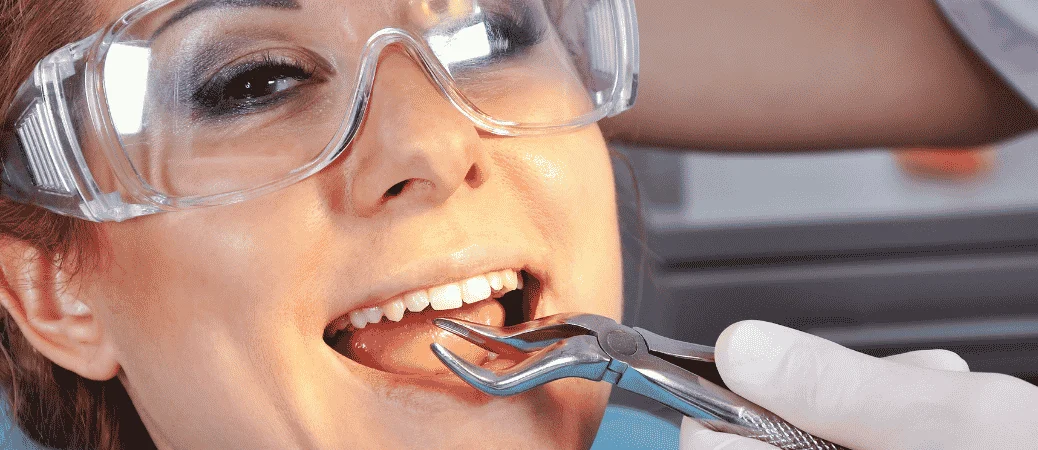
Cracks That Cannot Be Reliably Repaired
A split tooth happens when a crack runs all the way through the tooth, breaking it into two separate pieces. Once this happens, there’s no structure left for a crown to hold onto, so tooth extraction becomes necessary.
A vertical root fracture is another type of crack that’s tough to fix. It starts at the root and moves upward, often staying hidden below the gum line where regular X-rays can miss it.
This kind of crack usually leads to extraction and replacement because bacteria can slip into the fracture line and cause infection that repairs can’t stop.
Fractured teeth that reach the pulp or root are much harder to save, especially in molars, since these back teeth handle the heaviest chewing force.
Your general dentist may send you to an endodontist to check exactly how far the crack extends before deciding on extraction.
Replacing an Extracted Tooth With a Dental Implant
Leaving a gap after extraction isn’t a good long-term plan. Your other teeth can shift into space, your bite can change, and the jawbone in that area can start to shrink over time.
A dental implant is one of the most popular ways to fill that gap. It replaces both the missing tooth and its root, which helps keep your jawbone active and stable instead of wearing away.
The process involves placing a small titanium post in the jawbone, then topping it with a custom crown once healing is complete. This usually takes a few months, since the bone needs time to bond with the implant.
Combined extraction and implant treatment typically costs $4,000 to $7,000 or more, depending on your case and where you live.
Questions to Ask Before Choosing Treatment
Before you agree to extraction, it helps to ask a few direct questions so you fully understand your options.
- How deep is the crack, and does it reach the root?
- Is this a molar, and will it hold up under normal chewing after treatment?
- Should I get a second opinion from an endodontist?
- What replacement options make sense for this tooth’s location?
- What’s the full cost, including extraction and replacement, not just one part of it?
- What happens if I wait or try a less invasive fix first?
Weighing a root canal against extraction is often part of this conversation, since saving the natural tooth is usually preferred when it’s still possible.
Getting clear answers to these questions helps you avoid surprises and choose the path that fits your health and your budget.
Frequently Asked Questions
A cracked tooth can look minor on the surface but hide a much bigger problem underneath, so the right fix depends on the crack’s depth and location.
Here’s what you should know about spotting warning signs, choosing the right treatment, and what to expect along the way.
How can I tell if a chipped or cracked tooth needs urgent dental care?
Pay attention to sharp pain when you bite down or release pressure. This kind of pain often means the crack goes deeper than it looks.
Other warning signs include sudden sensitivity to hot or cold drinks, swelling around the tooth, or a visible line running across the enamel.
If you see any of these, it’s a good idea to learn about your crack type and symptoms so you know what level of care you need.
When is a dental crown the best option for repairing a cracked tooth?
A crown works well when the crack is limited to the visible part of your tooth and hasn’t reached the nerve. The crown wraps around the tooth like a cap, holding the pieces together so the crack can’t spread further.
Dentists often use a dental crown to stabilize a cracked tooth and prevent it from splitting apart over time. If the crack has already reached the inner pulp, you may need a root canal first, followed by a crown for protection.
Can dental bonding fix a small crack or chip in a tooth?
Yes, bonding can work for small, shallow cracks or chips. In this treatment, your dentist applies a tooth-colored resin to the damaged area and hardens it with a special light.
Bonding tends to work best when the crack is caught early and hasn’t spread below the surface. It’s a quicker and less expensive option than a crown, but it isn’t meant for deep or wide cracks.
What signs mean a cracked tooth may need to be extracted?
Extraction usually becomes necessary when the crack splits the tooth into two separate pieces or extends deep into the root.
A crack that crosses the floor of the pulp chamber, where the nerve sits, is also a strong sign that the tooth may not be saved through endodontic treatment.
Other red flags include a loose tooth, ongoing infection, or pain that keeps coming back even after treatment.
Your dentist will usually take an X-ray or use a microscope to see exactly how far the crack goes before making a final call.
Is it safe to wait before seeing a dentist after cracking a tooth?
It’s not a good idea to wait. Cracks tend to get worse over time, especially if you keep chewing on that side of your mouth.
Bacteria can also work their way into the crack, which raises your risk of infection or nerve damage. The sooner you act after cracking a tooth, the more treatment options you’ll have.
How much do crowns, bonding, and tooth extraction typically cost?
Costs vary depending on where you live and whether you have dental insurance, but here’s a general idea of typical price ranges:
- Bonding: Usually costs between $100 and $400 per tooth
- Crown: Typically ranges from $1,000 to $1,500 per tooth, not including any root canal that might be needed first
- Extraction: Simple extractions often run $75 to $300, while more complex extractions can cost $200 to $600 or more
Keep in mind that these numbers don’t include follow-up costs, like a replacement tooth after an extraction. Ask your dentist for a written estimate before starting treatment so you know exactly what to expect.