Porcelain veneer candidacy depends on the health of your teeth and gums, the amount of enamel available for bonding, your bite alignment, and your cosmetic goals.
If you have healthy teeth, sufficient enamel, and concerns such as stains, minor chips, or small gaps, veneers may be an option worth discussing with your dentist.
A self-check can point you in the right direction, but only an in-person exam can confirm it.
It helps to separate two ideas. Cosmetic suitability asks whether veneers can fix what bothers you about your smile.
Clinical readiness asks whether your mouth can support them for the long haul. Many people in Sparta pass the first test and still need a step or two before the second, such as treating a cavity, calming inflamed gums, or managing grinding.
That is good news. A “not yet” is far more common than a firm “no.” Knowing where you stand before you book helps you ask better questions and pick the plan that protects your natural teeth.
Key Takeaways
- Healthy teeth, healthy gums, enough enamel, and a stable bite form the base of veneer candidacy.
- Veneers change how teeth look; they do not move teeth or fix bite problems.
- Whitening, bonding, aligners, or crowns are sometimes the better fit for your goals.
What Makes Someone a Good Candidate for Porcelain Veneers?
A good candidate for porcelain veneers pairs a sound mouth with a cosmetic goal that thin porcelain shells are designed to handle.
Health, enamel, and bite come first, while stains, chips, gaps, and shape issues are the concerns veneers improve best.
A Quick Eligibility Check: Oral Health, Enamel, Bite, and Expectations
Run through these questions honestly. A “no” doesn’t rule you out. It flags something to raise at your visit.
- Oral health: Are you free of cavities, and do your gums stay pink and firm without bleeding when you brush or floss?
- Enamel: Is the outer layer of your front teeth in decent shape, without heavy wear from grinding, acid reflux, or years of hard brushing?
- Bite: Do your upper and lower teeth meet comfortably, without jaw soreness or a history of chipped fillings?
- Habits: Do you avoid chewing pens, biting nails, or opening packages with your teeth?
- Expectations: Are you comfortable knowing that most veneers involve removing a thin layer of enamel that never grows back?
That last point deserves weight. Traditional preparation removes roughly 0.3 to 0.5 mm of enamel from the front of each tooth.
Once removed, that tooth will always need a covering. Some cases allow minimal or no preparation, but that depends on your teeth and goals.
A consultation with Wojtowicz Dental is the place to confirm your answers, because X-rays and a bite check reveal things a mirror can’t.
Which Stains, Chips, Gaps, and Shape Concerns Can Veneers Improve?
Veneers handle several visible concerns at the same time, which is why they are one of the most flexible options in cosmetic dentistry. They suit you well when you want to change color, shape, and proportion together.
| Concern | How veneers help | Worth knowing |
| Deep stains | Cover the front surface with a stable shade | Best for stains whitening won’t lift |
| Small chips | Rebuild the edge and smooth the outline | Larger breaks may need a crown |
| Minor gaps | Widen teeth slightly to close space | Small gaps (under about 2 mm) work best |
| Misshapen teeth | Even out short, pointed, or uneven teeth | Shape is planned before any prep |
| Worn teeth | Restore length and edges | Wear from grinding needs a bite check first |
If only one or two teeth bother you, it is worth comparing veneers vs bonding for front teeth, since bonding keeps more natural teeth in place.
Can Veneers Help Slightly Crooked Teeth?
Yes, for mild misalignment. A tooth that sits a little forward or turns slightly can look straight once a veneer evens out its front surface. The tooth itself stays exactly where it was.
That difference shapes your plan. Veneers camouflage position; they don’t change it. Trying to hide real crowding or large rotations means removing more enamel, and the veneers then face uneven forces.
If your teeth overlap noticeably, straightening them first often gives a cleaner, more conservative result.
Many adults choose aligners at this stage, and clear aligners for adults over 40 work well for people who never had braces as kids.
Are Your Teeth and Gums Healthy Enough for Veneers?
Your teeth and gums are healthy enough for veneers when you have no active decay, your gums are free of disease, and enough sound enamel remains to bond to.
When any of those pieces is missing, the usual answer is to treat the problem first or choose a sturdier restoration.
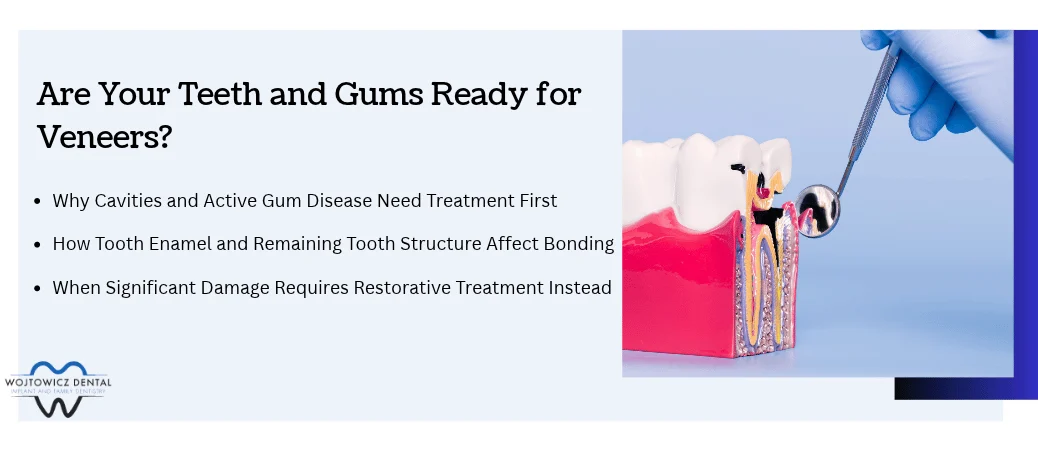
Why Cavities and Active Gum Disease Need Treatment First
A veneer placed over decay hides the problem while it keeps growing underneath. The cavity has to be cleaned and filled before any cosmetic work starts.
Gums matter just as much. Gingivitis (early gum inflammation) and periodontitis (deeper infection that affects bone) both make gums swell, bleed, and sometimes pull back.
When inflamed gums settle or recede later, the edge of a veneer shows as a visible line.
Signs to mention at your visit:
- Bleeding when you brush or floss
- Red, puffy, or tender gums
- Gums that look like they are pulling away from teeth
- Bad breath that doesn’t go away
Once gum disease has been treated, your dentist will evaluate whether the gums are healthy and stable enough for veneers.
The waiting period depends on the severity of the condition, treatment received, and individual healing progress.
How Tooth Enamel and Remaining Tooth Structure Affect Bonding
Porcelain bonds best to enamel, the hard outer layer of your tooth. Strong enamel gives the veneer a tight, lasting grip.
Several things thin enamel over time:
- Acid from reflux, frequent soda, or dry mouth
- Grinding and clenching
- Brushing too hard for years
- Natural wear with age
If your enamel is thin, your dentist checks how much remains with an exam and X-rays.
The bond to the layer underneath (dentin) is weaker, which changes the plan. Large old fillings also reduce the healthy surface a veneer can hold onto.
When Significant Damage Requires Restorative Treatment Instead
Some teeth need more support than a thin shell can give. A deep crack, a large filling, or heavy decay calls for restorative dentistry first.
If a tooth is cracked, cracked tooth treatment depends on how far the crack runs. For a front tooth that has lost a lot of structure, a crown covers the whole tooth and can match the shade of nearby veneers.
Knowing what to expect when you get a crown for a front tooth helps you weigh that path if your dentist suggests it.
How Do Teeth Grinding and Bite Problems Affect Eligibility?
Grinding and bite problems rarely disqualify you on their own, but they are a leading reason veneers chip or come loose early.
Your dentist needs to check how your teeth meet, decide whether the bite needs correcting first, and plan protection for nighttime grinding.
What an Occlusal Evaluation Reveals About Your Bite
An occlusal evaluation is a close look at how your upper and lower teeth come together. It is one of the most important steps in planning veneers and one of the easiest to rush.
Your dentist looks for:
- Flat, shiny wear spots on your teeth
- An edge-to-edge bite, where front teeth meet tip to tip
- A deep overbite or a crossbite
- Chipped fillings or past broken restorations
- Jaw soreness, tight muscles, or clicking
These clues show where force lands when you chew and grind. Veneers on teeth that take heavy, uneven force face a higher risk of fracture.
If you have noticed signs of teeth grinding damage, such as short or flattened front teeth, tell your dentist up front.
When Bite Correction Before Veneers May Be Needed
Bite correction comes first when the way your teeth meet would keep overloading the veneers. Common examples include a crossbite, an open bite where front teeth don’t touch, or a deep overbite.
Correction takes different forms. Your dentist might smooth a few high spots, recommend orthodontics to move teeth into a healthier position, or test a new bite shape in your temporary veneers before the final ones are made.
Moving teeth first adds time, yet it often means less enamel removal later.
Can a Night Guard Help Protect Veneers From Grinding?
A custom night guard helps a lot, but it does not stop grinding or guarantee your veneers stay intact. It acts as a cushion that takes the force while you sleep.
A few practical points:
- Choose custom-fit. Store-bought guards fit loosely, and soft ones lead some people to clench more.
- Hard acrylic is the usual pick for protecting porcelain.
- Wear it every night. A guard in the drawer protects nothing.
- Watch daytime clenching. Many people clench while driving or at a computer, and a night guard doesn’t cover those hours.
If you can’t tolerate a guard, say so. Your dentist may suggest a different material or approach.
When Is Another Treatment a Better Fit?
Another treatment fits better when your goal is narrow, when you want to keep more natural enamel, or when the real issue is tooth position or weak structure. Here’s how the main options line up.
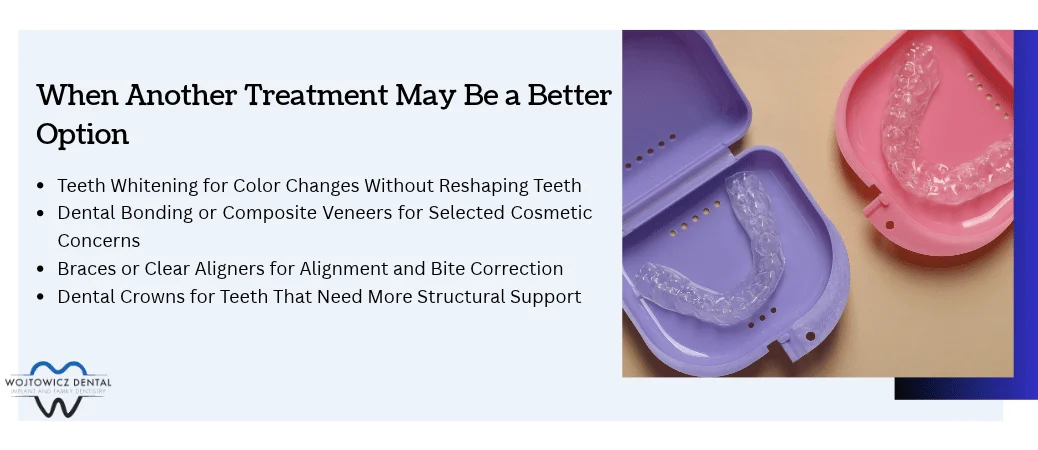
| Your main concern | Often a better first step |
| Color only | Professional whitening |
| One chip or small gap | Bonding |
| Crowding or bite issues | Braces or aligners |
| Badly broken or heavily filled tooth | Crown |
Teeth Whitening for Color Changes Without Reshaping Teeth
If your teeth are in good shape and you only want them brighter, professional teeth whitening is the gentlest place to start. No enamel is removed.
Whitening works best on surface and age-related yellowing. Some deep stains, like gray staining from certain medications, respond poorly, and that is where veneers earn their place.
If you plan to whiten some teeth and veneer others, whiten first. Porcelain doesn’t change color, so your dentist matches the veneer shade to your newly brightened teeth.
Dental Bonding or Composite Veneers for Selected Cosmetic Concerns
Dental bonding uses tooth-colored resin shaped right on your tooth. It handles a single chip, a small gap, or a slightly uneven edge, often in one visit with little or no enamel removal.
Composite veneers apply the same material across the whole front of a tooth. They cost less up front and are easy to repair.
The tradeoff is durability. Resin stains and wears faster than porcelain and needs touch-ups sooner. Younger adults often start with bonding and move to porcelain later.
Braces or Clear Aligners for Alignment and Bite Correction
When crooked teeth are your main concern, orthodontics fixes the cause. Braces or Invisalign clear aligners move teeth into a better position, which veneers cannot do.
Many people find that straight teeth plus whitening give them the smile they wanted, with no veneers needed.
Others straighten first and then add a few veneers for shape, needing less preparation because the teeth already sit in line.
Dental Crowns for Teeth That Need More Structural Support
A crown covers the entire tooth, while a veneer covers only the front. That full coverage protects teeth that are cracked, heavily filled, or worn down.
Crowns need more preparation, so they make sense when the tooth already needs the strength. Your dentist can combine crowns on weaker teeth with veneers on healthier ones and match the color across your smile.
What Should You Expect at a Veneer Consultation in Sparta, WI?
A thorough veneer consultation is a full exam that looks at your health, your bite, and your goals before anyone talks about final numbers.
Plan to share what you want your smile to look like, ask direct questions about enamel and cost, and leave with a written plan.
How Your Dentist Evaluates Oral Health, Bite, and Smile Goals
A careful consultation often runs 60 to 90 minutes. Expect your dentist to:
- Take X-rays to check for decay, bone levels, and root health
- Measure gum pockets to confirm your gums are healthy
- Study your bite and look for wear patterns
- Take photos and impressions or digital scans
- Talk through which teeth show when you smile and talk
Many practices then create a preview, such as a wax model or digital mockup, so you can see the shape before any tooth is touched. Some practices charge a consultation fee for this level of work, commonly in the range of $100 to $350.
When you visit Wojtowicz Dental, bring a few photos of smiles you like and a list of past dental work. Mention any grinding, jaw pain, or sensitivity, even if it seems minor.
If your plan grows beyond a few teeth, a full mouth reconstruction combines several treatments into one plan.
Questions to Ask About Enamel Removal, Risks, and Total Cost
Good questions lead to a clearer plan. Consider asking:
- How much enamel will you remove from each tooth?
- Could bonding or aligners reach my goal with less preparation?
- Which material do you recommend for my bite, and why?
- What happens if a veneer chips or comes loose?
- Will I need treatment first, like fillings, gum care, or orthodontics?
- Does the quote include temporaries, lab fees, follow-ups, and a night guard?
- How will we choose the final shade?
Ask for the answers in writing. A clear breakdown makes it easier to compare plans fairly.
What Veneer Placement and Long-Term Maintenance Involve
Placement takes more than one visit. Your dentist prepares the teeth, places temporary veneers while a lab makes the final ones, and then bonds the porcelain in place.
The temporary phase lets you test the shape and ask for changes.
After placement, the teeth under your veneers can still get cavities at the edges. Strong oral hygiene keeps them healthy:
- Brush twice a day with a soft brush and non-abrasive toothpaste
- Floss daily, paying attention to where the veneer meets the gum
- Keep regular cleanings and checkups
- Wear your night guard if one was prescribed
- Skip ice chewing and using teeth as tools
Veneers are long-term restorations, but no lifespan is guaranteed. One review found about 95.5% of porcelain veneers still in place at 10 years, though results varied. Plan for repair or replacement at some point.
Start With a Healthy Foundation and a Personalized Veneer Plan
Veneer candidacy rests on healthy teeth and gums, enough enamel to bond to, and a stable bite that won’t overload thin porcelain.
When those pieces are in place and your goals involve stains, chips, small gaps, or uneven shape, veneers are worth a serious look.
If something isn’t ready yet, that’s a normal part of the process.
Treating a cavity, calming your gums, managing grinding, or straightening teeth first often leads to a more conservative and longer-lasting result. Sometimes whitening, bonding, aligners, or a crown fits your goal better.
Before you book, write down what bothers you about your smile, any grinding or jaw symptoms, and your budget range. Bring that list to your consultation and ask for a written plan that covers each step and every cost.
Frequently Asked Questions
What disqualifies you from getting porcelain veneers?
Active decay, untreated gum disease, very thin enamel, and severe crowding or bite problems are the most common reasons you’d be told “not yet.”
Most of these are treatable first. Habits like nail biting or chewing hard objects also raise the risk of damage.
Can I get porcelain veneers if I grind my teeth?
Often yes, if your bruxism is managed. Your dentist checks your bite, may adjust it first, and will likely ask you to wear a custom night guard each night.
A guard reduces risk but does not stop grinding or guarantee the veneers won’t chip.
Can I get veneers after gum disease has been treated?
Yes, once your gums are healthy and stable. Many dentists want to see them stay stable for three to six months before placing veneers. Stable gums keep the veneer edges hidden and the fit secure.
How much would a full set of porcelain veneers cost in Sparta, WI?
There’s no fixed price, because a “full set” has no set number of teeth. Some people need four veneers and others need ten or more, and the total also includes any fillings, gum care, orthodontics, a night guard, and future replacement.
Ask your dentist for a written estimate that separates the per-tooth fee from the full treatment cost.
What should I know before committing to porcelain veneers?
Most veneers involve removing enamel that never grows back, so the decision is permanent for those teeth. Veneers change appearance without moving teeth, and they need daily care and eventual replacement.
A thorough veneer consultation with X-rays and a bite check is the best way to confirm the plan fits you.